 |
Log In |
| Home | Forums | Shops | Trade | Avatar | Inbox | Games | Donate |
| Not Logged In |
 Trisphee
| View Poll Results: Are you? | |||
| Self Studying |
   
|
41 | 68.33% |
| School Taught |
  
|
17 | 28.33% |
| Native Speaker |
  
|
2 | 3.33% |
| Voters: 60. You may not vote on this poll | |||
 |
|
|
Thread Tools |





 #756
#756
Haha xD yea it was.
I need to find my notes xp
I have an account on JapanesePod101.com now.. I had gotten a month free of the premium trial and Downloaded all I could (27+GB of stuff) So i have lessons upon lessons of stuff :3
Thanks to the site and their Pod Casts.. with in 2 weeks I have learned 30 Higarana! :D I have been studying hard during my breaks between cleaning the apartment *o*
I am also learning a bit about sentance structure! this place really makes things easy x3 I have all their lessons up to date so I'll be studying hard
AND I am getting a white board for xMas! so i can practice my Kana and Kanji with out wasting paper! x3
I need to find my notes xp
I have an account on JapanesePod101.com now.. I had gotten a month free of the premium trial and Downloaded all I could (27+GB of stuff) So i have lessons upon lessons of stuff :3
Thanks to the site and their Pod Casts.. with in 2 weeks I have learned 30 Higarana! :D I have been studying hard during my breaks between cleaning the apartment *o*
I am also learning a bit about sentance structure! this place really makes things easy x3 I have all their lessons up to date so I'll be studying hard
AND I am getting a white board for xMas! so i can practice my Kana and Kanji with out wasting paper! x3
 Posted 09-25-201109:15 AM 🖉
 #757
#757
Beginner Lesson: Japanese Pronunciation Series #1 - Basic 46 Sounds
from JapanesePod101!
:3 this is from my stuff among JapanesePod101
from JapanesePod101!
:3 this is from my stuff among JapanesePod101
Posted 12-26-201108:21 PM

 #759
#759
Yea that was where I started.. the Romaji version x.x and that never helped me read the doujinshi from aarinfantasy ;o;
Everyone told me that I should learn the Kana. Hiragana is one of the Kana :3 I still have to learn the katakana x.x, *falls over*
Everyone told me that I should learn the Kana. Hiragana is one of the Kana :3 I still have to learn the katakana x.x, *falls over*
Posted 12-26-201108:50 PM
#760
Ah. I think I might start with basic Roman stuff so get some of the spoken language down. Though my best learning is by writing and reading. I don't remember a heck of a lot of my Swedish vocab as far as speaking, but I can still read it well enough given what we covered in class. Most of the Japanese terms I remember I associate with a picture in my head of where I read it.
Posted 12-26-201108:54 PM
#761
Well there is a bunch of stuffs on the front with the Romaji ^-^ that and you can ignore the Kana characters and watch for the Romaji version ^-^
It helps with sound <3
It helps with sound <3
Posted 12-26-201108:56 PM
#765
yes mori is forest :3
And yes.. there are lots of kana :3
OH! http://www.learn-japanese.info/indexw.html
is a good site for vocab words ^-^
Hiragana (Half of the Kana)
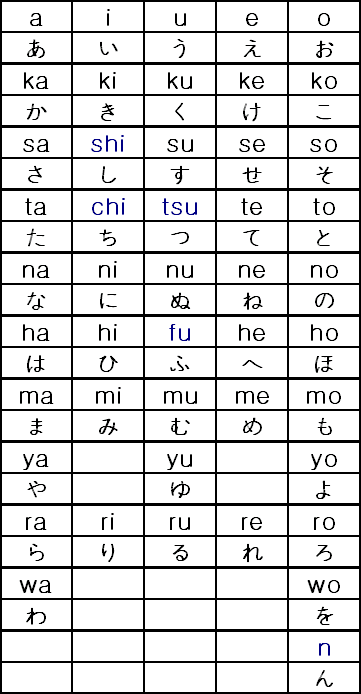
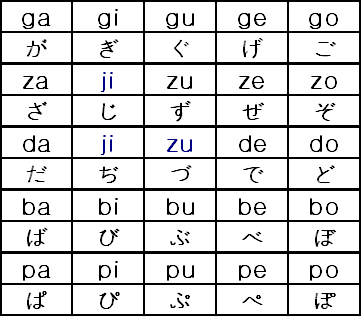
Katakana (Other Half of the Kana)
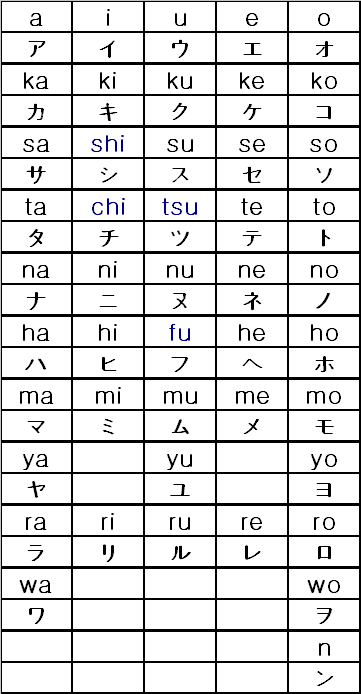
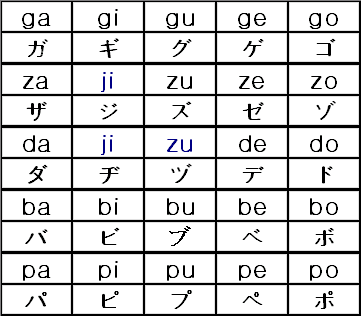
.. then there are the the ones like Nya Nyu Nyo Pya Pyu Pyo Mya Myu Myo =w=, these are hard to remember the hiragana for..
And yes.. there are lots of kana :3
OH! http://www.learn-japanese.info/indexw.html
is a good site for vocab words ^-^
Hiragana (Half of the Kana)
Katakana (Other Half of the Kana)
.. then there are the the ones like Nya Nyu Nyo Pya Pyu Pyo Mya Myu Myo =w=, these are hard to remember the hiragana for..
Posted 12-26-201109:49 PM
 #766
#766
to write the ones like Nya Nyu Nyo Pya Pyu Pyo Mya Myu Myo, you just use the regular Na Nu No Pa Pu Po et cetera, and add the corresponding Ya Yu Yo character after it, slightly smaller.
Also, pronunciation usually turns out better if you learn the hiragana and read from that because you don't have any preconceived ideas about how each character should sound, whereas when reading from romanji it's easy to pronounce each letter as it should be in English or another language.
Also, pronunciation usually turns out better if you learn the hiragana and read from that because you don't have any preconceived ideas about how each character should sound, whereas when reading from romanji it's easy to pronounce each letter as it should be in English or another language.
This signature intentionally left blank.
Posted 01-06-201201:42 PM
#767
Actually according to my kana cards and my kana lessons you use..
Ni+ ya,yu,yo depending on what one you want owo
nya nyu nyo
ni+ya ni+yu ni+yo owo
mi+ya mi+yu mi+yo
I'm ready to start on katakana! x3
Japanese pod 101 helps with pronoucniation
REAL japanese people teaching japanese xD
Ni+ ya,yu,yo depending on what one you want owo
nya nyu nyo
ni+ya ni+yu ni+yo owo
mi+ya mi+yu mi+yo
I'm ready to start on katakana! x3
Japanese pod 101 helps with pronoucniation
REAL japanese people teaching japanese xD
Posted 01-06-201202:52 PM
|
«
Previous Thread
|
Next Thread
»
| Currently Active Users Viewing This Thread: 1 (0 members and 1 guests) | |
| Thread Tools | |


|
|

All content is copyright © 2010 - 2026 Trisphee.com
FAQ | E-Mail | Terms of Service | Privacy Policy | Forum Rules
Twitter | Facebook | Tumblr
FAQ | E-Mail | Terms of Service | Privacy Policy | Forum Rules
Twitter | Facebook | Tumblr